Saturday, February 17, 2007
Lexical phonology Discussion
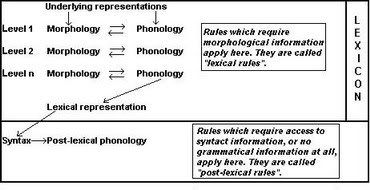
Here is a diagram of the overall structure of the lexical phonology model:

Friday, February 16, 2007
Lexical phonology
Lexical phonology is an approach to phonology that accounts for the interactions of morphology and phonology in the word building process.

The lexicon plays a central, productive role in the theory. It consists of ordered levels, which are the domain for certain phonological or morphological processes.
The lexicon plays a central, productive role in the theory. It consists of ordered levels, which are the domain for certain phonological or morphological processes.
Wednesday, February 14, 2007
Example (metrical tree)
Here is an example of a metrical tree of the word metricality:
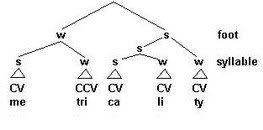
On the word and foot level, s and w indicate relative stress. The w indicates weaker prominence, and the s indicates relative stronger prominence.The internal syllable structure in the above figure has been omitted and is represented by triangles. Within the syllable, s and w refer to stronger and weaker degrees of sonorance, not stress, and s corresponds to the syllable nucleus, which is the most sonorant segment in a syllable.In metrical trees, the strongest unit of the word is the one that is dominated by s all the way up the tree.
On the word and foot level, s and w indicate relative stress. The w indicates weaker prominence, and the s indicates relative stronger prominence.The internal syllable structure in the above figure has been omitted and is represented by triangles. Within the syllable, s and w refer to stronger and weaker degrees of sonorance, not stress, and s corresponds to the syllable nucleus, which is the most sonorant segment in a syllable.In metrical trees, the strongest unit of the word is the one that is dominated by s all the way up the tree.
Tuesday, February 13, 2007
Metrical phonology
Metrical phonology is a phonological theory concerned with organizing segments into groups of relative prominence. Segments are organized into syllables, syllables into metrical feet, feet into phonological words, and words into larger units. This organization is represented formally by metrical trees and grids.
Monday, February 12, 2007
Multi-dimensional representations
Autosegmental phonology treats phonological representations as multi-dimensional, having several tiers. Each tier is made up of a linear arrangement of segments. The tiers are linked to each other by association lines that indicate how the segments on each tier are to be pronounced at the same time.

Sunday, February 11, 2007
Segmental phonology
Autosegmental phonology is a non-linear approach to phonology that allows phonological processes, such as tone and vowel harmony, to be independent of and extend beyond individual consonants and vowels.
As a result, the phonological processes may influence more than one vowel or consonant at a time.
As a result, the phonological processes may influence more than one vowel or consonant at a time.
Saturday, February 10, 2007
Models of phonology
Different models of phonology contribute to our knowledge of phonological representations and processes:

- In classical phonemics, phonemes and their possible combinations are central.
- In standard generative phonology, distinctive features are central. A stream of speech is portrayed as linear sequence of discrete sound-segments. Each segment is composed of simultaneously occurring features.
- In non-linear models of phonology, a stream of speech is represented as multidimensional, not simply as a linear sequence of sound segments. These non-linear models grew out of generative phonology:
o autosegmental phonology
o metrical phonology
o lexical phonology
SIL International
Subscribe to:
Posts (Atom)

