Friday, February 9, 2007

Phonology and phonetics

Phonology …
Is the basis for further work in morphology, syntax, discourse, and orthography design.

Website Promotion Service

Analyzes the sound patterns of a particular language by
• determining which phonetic sounds are significant, and
• explaining how these sounds are interpreted by the native speaker.

Phonetics …
Is the basis for phonological analysis.
Analyzes the production of all human speech sounds, regardless of language.

Thursday, February 8, 2007

Phonology

What is phonology?
Phonology is the study of how sounds are organized and used in natural languages.
The phonological system of a language includes


  • an inventory of sounds and their features, and

  • rules which specify how sounds interact with each other.

Phonology is just one of several aspects of language. It is related to other aspects such as phonetics, morphology, syntax, and pragmatics.


Here is an illustration that shows the place of phonology in an interacting hierarchy of levels in linguistics:


Wednesday, February 7, 2007

Development of the field

In ancient India, the Sanskrit grammarian Pāṇini (c. 520–460 BC), who is considered the founder of linguistics, in his text of Sanskrit phonology, the Shiva Sutras, discovers the concepts of the phoneme, the morpheme and the root. The Shiva Sutras describe a phonemic notational system in the fourteen initial lines of the Aṣṭādhyāyī. The notational system introduces different clusters of phonemes that serve special roles in the morphology of Sanskrit, and are referred to throughout the text. Panini's grammar of Sanskrit had a significant influence on Ferdinand de Saussure, the father of modern structuralism, who was a professor of Sanskrit.

The Polish scholar Jan Baudouin de Courtenay coined the word phoneme in 1876, and his work, though often unacknowledged, is considered to be the starting point of modern phonology. He worked not only on the theory of the phoneme but also on phonetic alternations (i.e., what is now called allophony and morphophonology). His influence on Ferdinand de Saussure was also significant.

Prince Nikolai Trubetzkoy's posthumously published work, the Principles of Phonology (1939), is considered the foundation of the Prague School of phonology. Directly influenced by Baudouin de Courtenay, Trubetskoy is considered the founder of morphophonology, though morphophonology was first recognized by Baudouin de Courtenay. Trubetzkoy split phonology into phonemics and archiphonemics; the former has had more influence than the latter. Another important figure in the Prague School was Roman Jakobson, who was one of the most prominent linguists of the twentieth century.

Website Promotion Service

In 1968, Noam Chomsky and Morris Halle published The Sound Pattern of English (SPE), the basis for Generative Phonology. In this view, phonological representations (surface forms) are structures whose phonetic part is a sequence of phonemes which are made up of distinctive features. These features were an expansion of earlier work by Roman Jakobson, Gunnar Fant, and Halle. The features describe aspects of articulation and perception, are from a universally fixed set, and have the binary values + or -. Ordered phonological rules govern how this phonological representation (also called underlying representation) is transformed into the actual pronunciation (also called surface form.) An important consequence of the influence SPE had on phonological theory was the downplaying of the syllable and the emphasis on segments. Furthermore, the Generativists folded morphology into phonology, which both solved and created problems.

In the late 1960s, David Stampe introduced Natural Phonology. In this view, phonology is based on a set of universal phonological processes which interact with one another; which ones are active and which are suppressed are language-specific. Rather than acting on segments, phonological processes act on distinctive features within prosodic groups. Prosodic groups can be as small as a part of a syllable or as large as an entire utterance. Phonological processes are unordered with respect to each other and apply simultaneously (though the output of one process may be the input to another). The second-most prominent Natural Phonologist is Stampe's wife, Patricia Donegan; there are many Natural Phonologists in Europe, though also a few others in the U.S., such as Geoffrey Pullum. The principles of Natural Phonology were extended to morphology by Wolfgang U. Dressler, who founded Natural Morphology.

In 1976 John Goldsmith introduced autosegmental phonology. Phonological phenomena are no longer seen as one linear sequence of segments, called phonemes or feature combinations, but rather as some parallel sequences of features which reside on multiple tiers.Government Phonology, which originated in the early 1980s as an attempt to unify theoretical notions of syntactic and phonological structures, is based on the notion that all languages necessarily follow a small set of principles and vary according to their selection of certain binary parameters. That is, all languages' phonological structures are essentially the same, but there is restricted variation that accounts for differences in surface realizations. Principles are held to be inviolable, though parameters may sometimes come into conflict. Prominent figures include Jonathan Kaye (Linguist), Jean Lowenstamm, Jean-Roger Vergnaud, Monik Charette, John Harris, and many others.

In a course at the LSA summer institute in 1991, Alan Prince and Paul Smolensky developed Optimality Theory—an overall architecture for phonology according to which languages choose a pronunciation of a word that best satisfies a list of constraints which is ordered by importance: a lower-ranked constraint can be violated when the violation is necessary in order to obey a higher-ranked constraint. The approach was soon extended to morphology by John McCarthy and Alan Prince, and has become the dominant trend in phonology. Though this usually goes unacknowledged, Optimality Theory was strongly influenced by Natural Phonology; both view phonology in terms of constraints on speakers and their production, though these constraints are formalized in very different ways.

Monday, February 5, 2007

Change of a phoneme inventory over time

The particular sounds which are phonemic in a language can change over time. At one time, [f] and [v] were allophones in English, but these later changed into separate phonemes. This is one of the main factors of historical change of languages as described in historical linguistics.

Sunday, February 4, 2007

Phonemic distinctions or allophones

If two similar sounds do not belong to separate phonemes, they are called allophones of the same underlying phoneme. For instance, voiceless stops (/p/, /t/, /k/) can be aspirated. In English, voiceless stops at the beginning of a word are aspirated, whereas after /s/ they are not aspirated. (This can be seen by putting the fingers right in front of the lips and noticing the difference in breathiness in saying 'pin' versus 'spin'.) There is no English word 'pin' that starts with an unaspirated p, therefore in English, aspirated [ph] (the [h] means aspirated) and unaspirated [p] are allophones of an underlying phoneme /p/.

Website Promotion Service

The /t/ sounds in the words 'tub', 'stub', 'but', and 'butter' are all pronounced differently (in American English at least), yet are all perceived as "the same sound", therefore they constitute another example of allophones in English.

Another example: in English and many other languages, the liquids /l/ and /r/ are two separate phonemes (minimal pair 'life', 'rife'); however, in Korean these two liquids are allophones of the same phoneme, and the general rule is that [r] comes before a vowel, and [l] does not (e.g. Seoul, Korea). A native speaker will tell you that the [l] in Seoul and the [r] in Korean are in fact the same sound. What happens is that a native Korean speaker's brain recognises the underlying phoneme /l/, and, depending on the phonetic context (whether before a vowel or not), expresses it as either [r] or [l]. Another Korean speaker will hear both sounds as the underlying phoneme and think of them as the same sound. This is one reason why most people have a marked accent when they attempt to speak a language that they did not grow up hearing; their brains sort the sounds they hear in terms of the phonemes of their own native language.

Saturday, February 3, 2007

Phoneme inventories

Doing a phoneme inventory
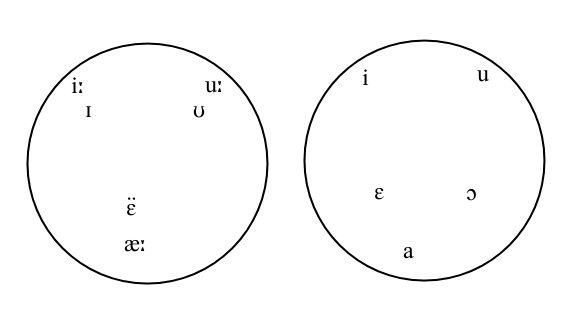
The vowels of modern (Standard) Arabic and (Israeli) Hebrew from the phonetic point of view. Note that the two circles are totally separate—none of the vowel-sounds made by speakers of one language are made by speakers of the other.


Part of the phonological study of a language involves looking at data (phonetic transcriptions of the speech of native speakers) and trying to deduce what the underlying phonemes are and what the sound inventory of the language is. Even though a language may make distinctions between a small number of phonemes, speakers actually produce many more phonetic sounds. Thus, a phoneme in a particular language can be pronounced in many ways.

Looking for minimal pairs forms part of the research in studying the phoneme inventory of a language. A minimal pair is a pair of words from the same language, that differ by only a single sound, and that are recognized by speakers as being two different words. When there is a minimal pair, the two sounds represent separate phonemes.

Friday, February 2, 2007

Avoiding Confusion from Orthographical Ambiguity, the IPA

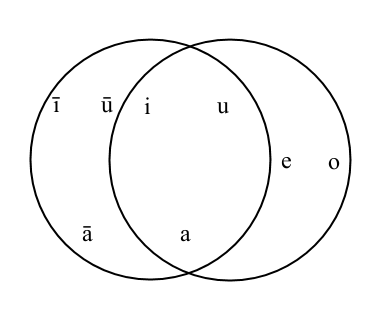
The vowels of modern (Standard) Arabic and (Israeli) Hebrew from the phonological point of view. Note the intersection of the two circles—the distinction between short a, i and u is made by both speakers, but Arabic lacks the mid articulation of short vowels, while Hebrew lacks the distinction of vowel length.

Website Promotion Service

The writing systems of some languages are based on the phonemic principle of having one letter (or combination of letters) per phoneme and vice-versa. Ideally, speakers can correctly write whatever they can say, and can correctly read anything that is written. In practice, this ideal is more nearly achieved in some languages than in others. In the writing systems of many languages, different spellings can be used for the same phoneme (e.g. English: "rude" /ɹu:d/ and "food" /fu:d/ have the same medial vowel sound but that sound is represented differently in each word), and the same letter (or combination of letters) can represent different phonemes. For instance, the letter combination "th" is used in English to represent /θ/ in "thin" /θɪn/ and /ð/ in "this" /ðɪs/, or the "c" of European Spanish represents /θ/ in "gracias" ['gra.θi.əs] (thank you) or /k/ in "cabo" ['ka.bo] (cape). In order to avoid confusion based on orthography, phonologists represent sounds by writing them in a phonetic alphabet which ascribes rigorous characteristics to each symbol. This system of writing is called the International Phonetic Alaphabet, it is used universally amongst people who require accurate descriptions of phonetic material, and is often referred to as the IPA.

Website Promotion Service

IPA symbols are sometimes written between two slashes: " / / " (but without the quotes) as a way to denote what is minimally distinctive in a particular language (phonemes). On the other hand, a representation of the actual sounds produced by a speaker is enclosed by square brackets: " [ ] " (again, without quotes). This notation is used to convey a transcription of what sounds were produced in a particular instance of speech. For example, our English grammar will include a phoneme /p/ that will be realized as [p] or [pʰ] in a particular act of speech. Remember, whether a particular speaker produces [p] or [pʰ] is unimportant to meaning in the case of English (a listener only has to distinguish /p/ from /d/ or any other English phoneme which is minimally distinctive). nonetheless, the case of aspirated [p] could be interesting to linguists for many other reasons.